 BitCloudVPS
No-KYC VPS From $3 — USDT on 7 Chains, No ID
No-KYC VPS from $3* when you fund $50+. Nano list $3. No passport, phone or card. 21 locations, XMR first-class. Deploy today.
No-KYC VPS from $3/mo: token-only or email + password, then a Bitcoin or USDT invoice. No passport, phone, or card. Crypto-only billing removes the card processor; it does not make the VM invisible.
What no-KYC VPS means here
A no-KYC VPS is a root KVM you can rent without a passport, selfie, phone number, or billing address. At BitCloudVPS the form is email (or token-only), a 12-character password, a plan, a location, and a coin. There is no ID step at $200, at the fiftieth server, or on dedicated.
Pick Reykjavik / Iceland or Zurich / Switzerland when the query is speech-jurisdiction. Same SKU price as Amsterdam. Pay USDT-TRC20, BTC, or XMR on one invoice.
Business $24/mo (6 vCPU / 16 GB DDR5) is the production size. Crypto invoice, no KYC.
Launch nowWhat we do not collect
- Government ID, selfie, or liveness check
- Phone / SMS verification
- Street address or proof of address
- Legal name (the panel shows the email handle)
- Date of birth, employer, source-of-funds, PEP screening
We still need a working inbox to deliver SSH and invoices (disposable and self-hosted work) and an on-chain payment. Optional: panel account, PGP on file, PTR, extra IPv4. None of those trigger identity checks.
Signup without KYC
- Choose a plan and a region — Iceland, Switzerland, Netherlands, Romania, plus seventeen more under the same account.
- Set email + password (or token-only) and pick BTC, XMR, USDT (TRC-20/ERC-20/BEP-20/SPL/Polygon/Arbitrum/Optimism), ETH, BNB, SOL, LTC, TRX, XRP, DOGE, DASH, ADA, or GRAM (TON).
- Pay the live-rate invoice. VPS imaging typically starts about a minute after confirmation; dedicated is 2–4 hours.
- SSH is the source of truth. The panel is optional for reboot, reverse DNS, and rebuilds.
No-KYC VPS plans
Same hardware class, same no-KYC checkout, same DDoS-included network. Nano is 1 vCPU / 2 GB; the 2 vCPU / 4 GB production class is Starter.
| Plan | vCPU | RAM | NVMe | Port | Effective $/mo (year term) |
|---|---|---|---|---|---|
| Nano | 1 | 2 GB ECC | 40 GB | 1 Gbps | $3 |
| Starter | 2 | 4 GB DDR4 ECC | 60 GB | 1 Gbps | $6.80 |
| Plus | 4 | 8 GB DDR4 ECC | 120 GB | 2.5 Gbps | $10.80 |
| Business | 6 | 16 GB DDR5 ECC | 240 GB | 5 Gbps | $24.00 |
| Pro | 8 | 24 GB DDR5 ECC | 400 GB | 5 Gbps | $36 |
| Max | 12 | 32 GB DDR5 ECC | 640 GB | 10 Gbps | $60 |
Iceland, Switzerland, USDT
Narrow searches (“no KYC VPS Iceland”, “Zurich USDT VPS”) should land on a page that names those tokens. This one does. Reykjavik sits outside the EU with no mandatory retention. Zurich is non-EU, FADP, SwissIX. USDT-TRC20 is the cheap stable rail; XMR is the opaque rail. Compare the broader field on best offshore VPS 2026.
What no-KYC will not do
It is not invisibility, not a skipped card processor pretending to be anonymous, and not bulletproof crime hosting. CSAM, phishing, spam, and paid attacks stay prohibited. Local law of the facility still applies. Encrypt data at rest in the guest if that is your threat model — see the limits of no-KYC anonymity.
Also on this site
More rankings and guides
- Best anonymous VPS 2026
- x402 VPS (USDC on Base)
- USDC / USDT VPS
- Whonix VPS, nested virt
- Best no-email VPS
- Buy VPS with crypto
Paying without leaving a paper trail
No-KYC at signup only holds if payment does not undo it. Our checkout takes 19 assets: BTC, XMR, ETH, BNB, SOL, LTC, TRX, XRP, DOGE, DASH, ADA, GRAM on TON, and USDT on seven networks (TRC-20, ERC-20, BEP-20, Polygon, Arbitrum, Optimism, SPL). XMR is there for buyers who care about the on-chain graph; USDT on TRC-20 is the practical pick when you want low fees and a stable price.
An account itself is optional to identify: signup works with a token only, and email is optional. If you fund a wallet balance, bonus tiers apply at $1,000 (+10%) and $2,000 (+40%), which is one way to prepay a year of Nano at its flat $36/yr without keeping a card on file — because there is no card field at all.
Term math on a nameless account: month, quarter, year, and Nano's flat price
The direct answer: the billing terms carry the discounts, and the account carries none of your identity — the two systems never touch. Monthly terms bill at list price with no discount. Quarterly takes 10% off. Annual takes 20% off, which is how Starter's $8.50 list becomes $6.80/mo and Business's $30 list becomes $24/mo on the year. Nano is the standing exception: a flat $36/yr — $3/mo effective against its $5.49/mo list — with no further discount to chase, which makes it the cheapest way to hold a permanent, nameless footprint on the network.
What this means in practice for a no-KYC buyer is a decision about on-chain cadence rather than price hunting. Paying monthly means twelve invoices and twelve payment events a year; annual collapses that to one transfer at a 20% lower rate. For a public-chain asset like BTC or USDT, fewer events is both cheaper in fees and quieter in aggregate, which is why annual terms and no-KYC checkout tend to reinforce each other. The account model is constant across all of it: token-only signup, email optional, no ID step at any tier from Nano to Max, and every plan ships with NVMe, ECC RAM, unmetered 1–10 Gbps ports, 1x IPv4 and a /64 of IPv6.
One nuance worth stating: switching terms is a per-service decision, so a mixed fleet — a Nano probe on its flat year, a Business box monthly while you size it — is normal and bills independently from the same account.
BitCloudVPS Nano · flat $36/yr · token-only signup
Deploy in 60 secondsFund-account bonuses on a no-KYC account: the $1,000 and $2,000 tradeoff
The bonus tiers are the aggressive end of this checkout's math: fund the account with $1,000 and it holds $1,100 of credit; fund $2,000 and it holds $2,800. That 40% tier exceeds anything the term discounts offer, and the credit is universal — it pays VPS, storage and dedicated invoices at any of the 21 sites, renewing automatically until it runs dry. For someone consolidating a year of servers — say two Business annual terms and a storage box — a $2,000 top-up covers the lot with room left over.
The tradeoff deserves equal billing. A $2,000 top-up is a single, large, timestamped on-chain event; on public chains like Tron or Bitcoin, its amount and timing are visible to anyone watching, and it concentrates prepaid value — and prepayment risk — in one account. The honest mitigations are asset choice and sizing: funding in XMR keeps the transfer itself quiet; funding to the $1,000 tier captures +10% without four-figure exposure; and treating the balance as spent money rather than savings keeps the risk bounded. Nothing about the tiers requires identity — they attach to the account, and the account attaches to a token — but the payment event itself is only as private as the coin you fund with.
Who should skip it: single-Nano buyers, whose $36/yr is better paid as one small invoice; and anyone whose threat model treats large crypto transfers as the thing to avoid. The per-invoice path stays open at every tier.
Scenario fork: which buyer this page fits, and which it does not
This page is the right landing when your requirement is precise: a virtual server whose hosting relationship contains no identity, payable in crypto, on plans that do not escalate into verification as they grow. Concretely, that covers the solo operator moving off a card-billed host; the developer holding infrastructure footprints across several jurisdictions on one token-only account; and the small team standardizing on crypto-only because a shared card bill is its own liability. If that is you, the catalog needs no special handling: pick the tier by workload, the pin by latency, the term by cash flow, and the coin by how public you want the payment event to be.
It is the wrong fit when the requirement is actually anonymity of the operator rather than absence of KYC — the differences are documented on our limits page, and they are behavioral, not contractual: no checkout can unname a domain registration or stop correlated logins. It is also the wrong fit if you need fiat rails; this checkout is crypto-only by design, with 19 assets from BTC to GRAM and USDT on seven networks, and there is no card fallback to soften that. And if your workload is one short-lived experiment, monthly list price on Nano or Starter is the honest entry — no discounts are worth prepaying a year for a box that may not live a month.
BitCloudVPS Business · any of 21 sites · $24/mo on the annual term
Deploy in 60 secondsWhat no-KYC means on this sheet, clause by clause
No-KYC is used loosely across the industry, so the concrete version on this network deserves a precise statement. Signup: an account is created by token — a credential, not an identity — and the email field is optional, meaning a complete hosting relationship can exist with no address attached. Payment: 19 crypto assets settle every invoice — BTC, XMR, ETH, BNB, SOL, LTC, TRX, XRP, DOGE, DASH, ADA, GRAM on TON, and USDT on seven networks — with no card processor, no bank, and therefore no compliance file anywhere. Post-signup: no plan tier triggers document requests, from the flat $36/yr Nano through the dedicated ladder's Ultra at $449.50/mo. The operator of record is Harborline Node Ltd., registered in Saint Kitts and Nevis, which sets the corporate relationship outside the jurisdictions where identity collection is customary.
What no-KYC does not claim is equally concrete, because honest pages keep the boundary visible. It does not make your traffic anonymous — certificates, domain records, and administration habits still correlate, as the limits page details. It does not exempt content from the law of the rack's jurisdiction or from abuse processing, both of which continue. And it does not vary by tier or rack: every location from IS-RKV to KZ-ALA, every plan from Nano to Max, shares the same posture, which removes the suspicion that privacy is an upsell — the sheet prices identical everywhere, −10% quarterly and −20% annually across the catalog. For the buyer, the practical reading is simple: the hosting layer of your operational plan contributes zero identity by design, and everything that still correlates is yours to manage — which is exactly the division of labor a privacy-conscious buyer should want from a host.
Where the limits are (October 2026)
Keep the threat model precise. Anonymous-adjacent hosting removes the host-side identity trail: token-only signup, optional email, no KYC review, crypto invoices that record a txid rather than a name. It does not blind the host to traffic it must carry, it does not make a logged-in panel session anonymous, and it does not protect workloads that identify themselves — an admin login from your home IP defeats the whole design. Exact limits of no-KYC anonymity. OPSEC guide. Full checklist. Payment-side note: chain analysis happens on public blockchains, not at the host. Coin choice and network choice are your OPSEC knobs, and the checkout keeps 19 of them open.
Peer check: the no-KYC bar keeps rising: NulNet signs you up with a plain email at every tier, and VPSbit offers a 32-character browser-stored token — no email at all if you want it. Checked October 2026.
How to sign up and deploy — step by step
How to sign up and deploy — step by step
No email, no password: an access key is created at checkout and the invoice clears in crypto. Desktop shots below; phones get the mobile UI.
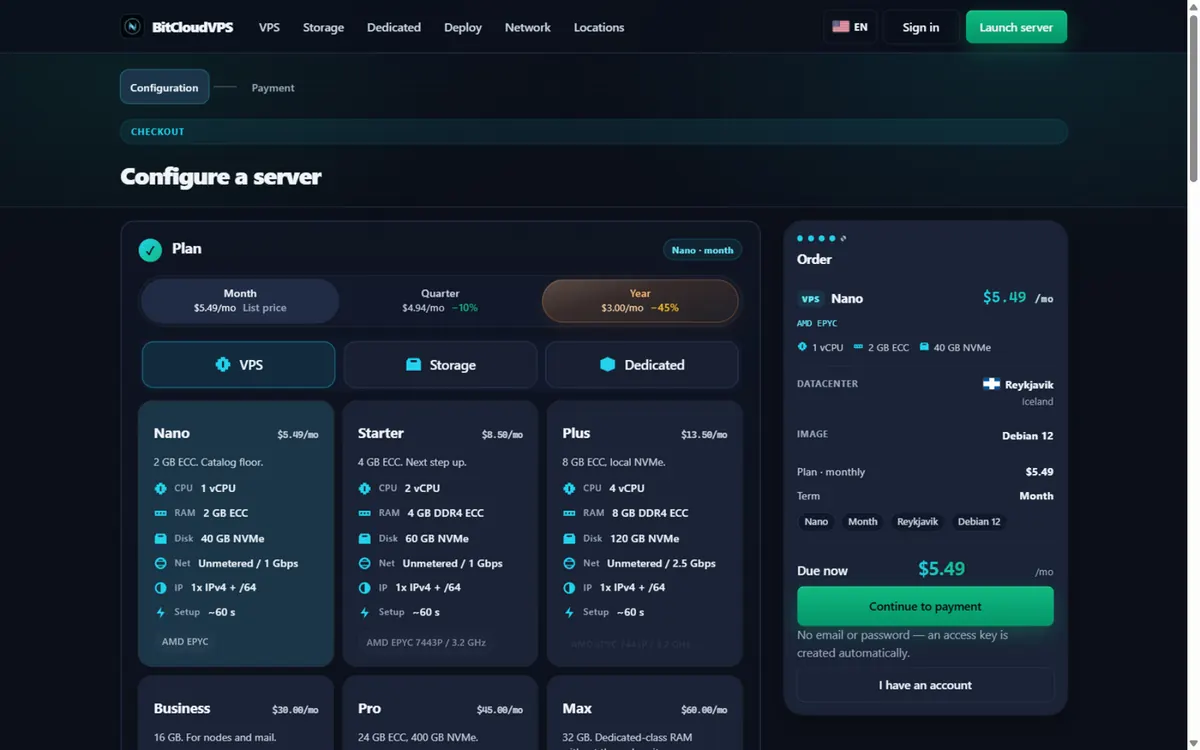
1Pick a plan. Open the deploy page and keep the Year term: Nano is $5.49/mo list and $3.00/mo flat on the annual term. No email and no password are required at any step. 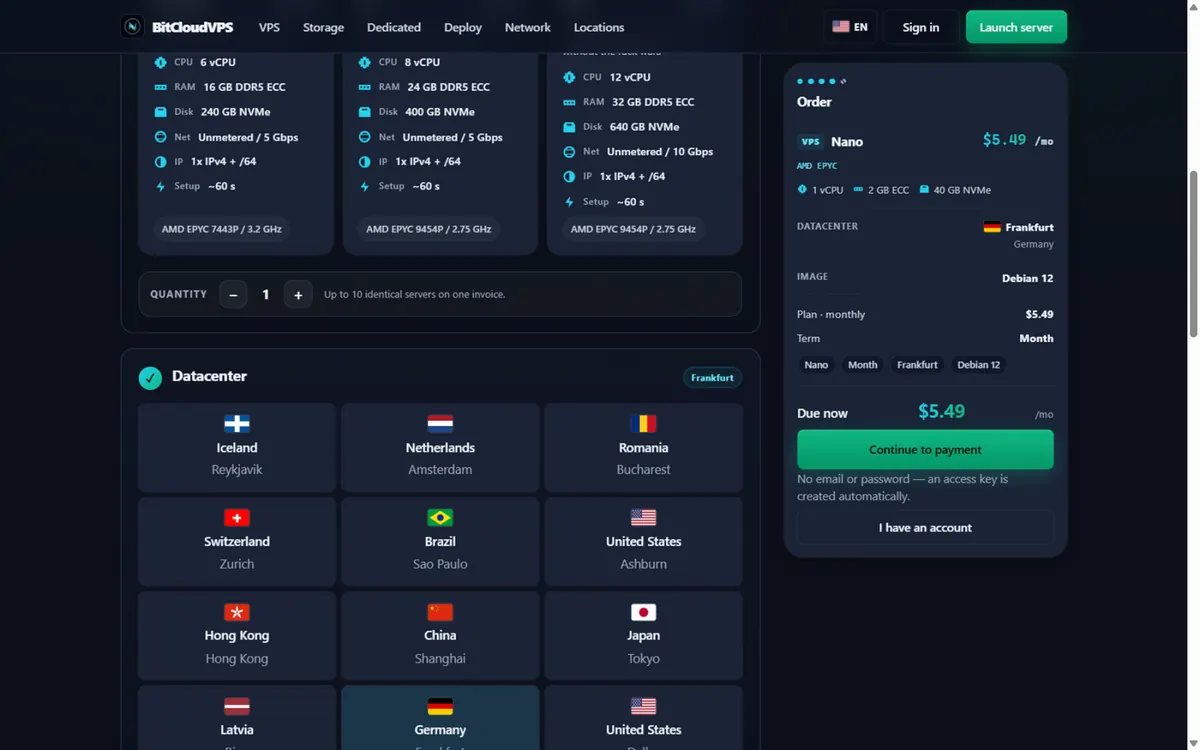
2Choose a datacenter. Click a location: 21 sites from Reykjavik to Singapore share the same price per SKU. This walkthrough selects Frankfurt (DE-CIX, Germany). 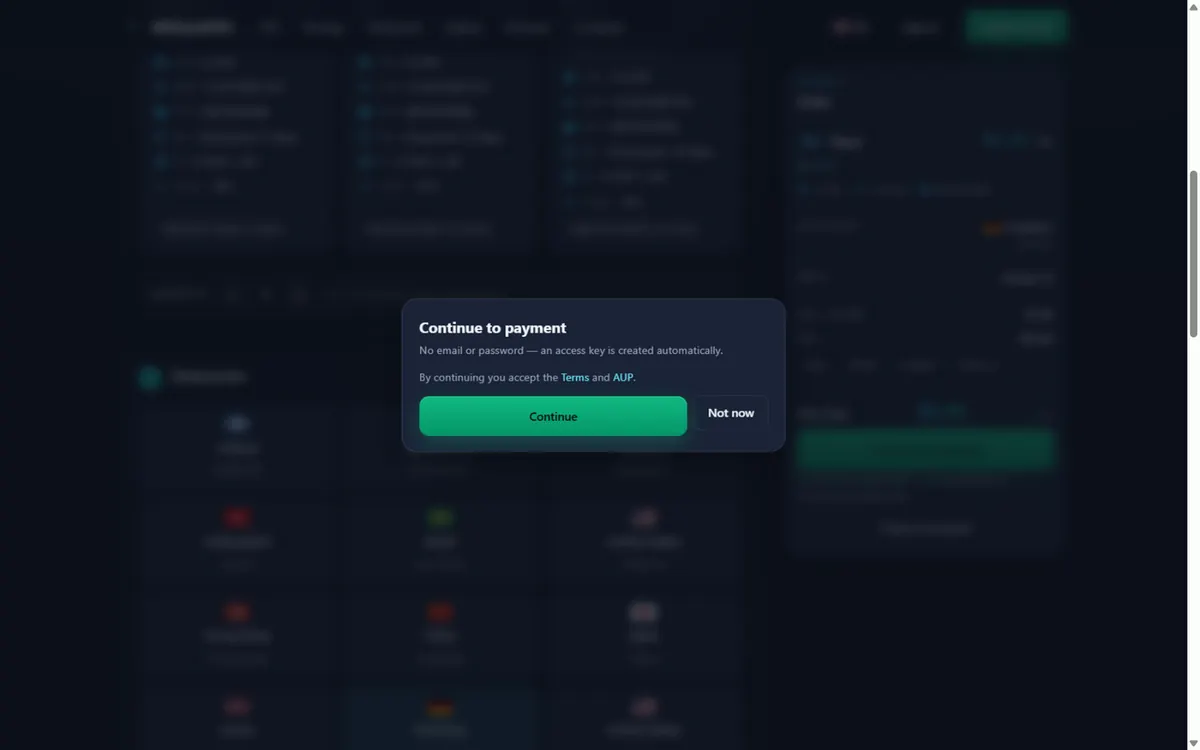
3Continue to payment. Press Continue to payment and accept the Terms and AUP. No email, no password — there is nothing to leak. 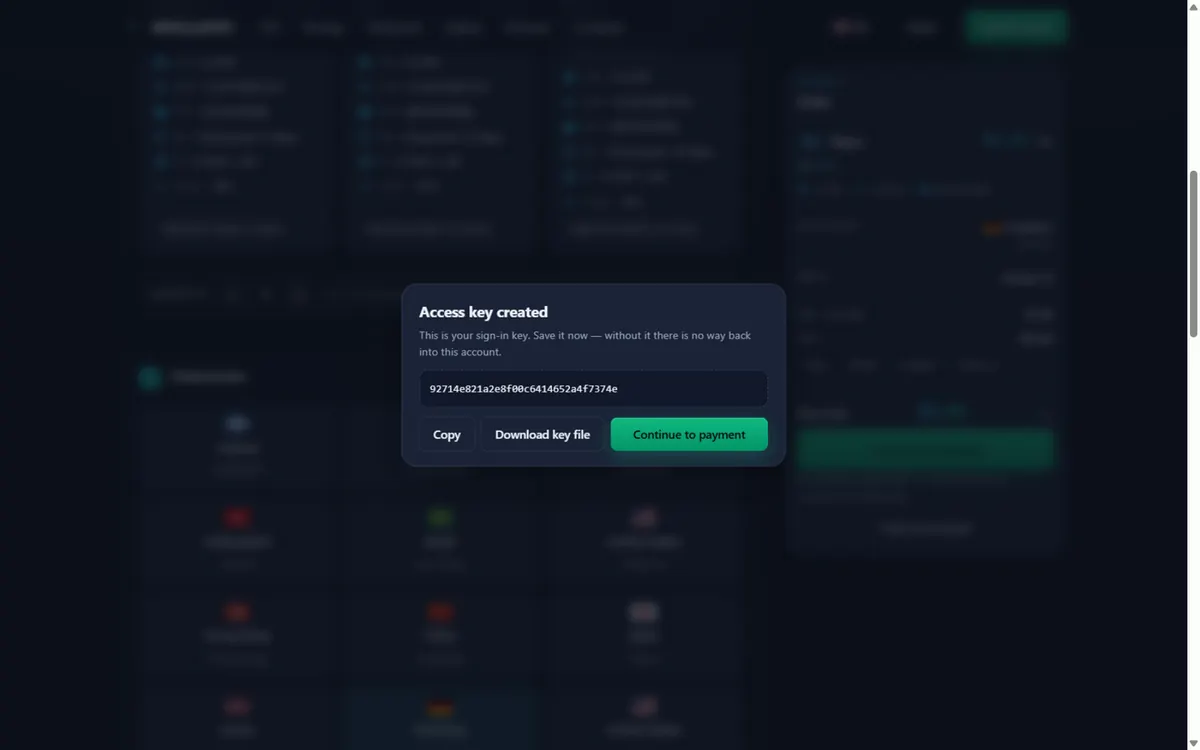
4Save your access key. An anonymous token account is created automatically. Copy or download the access key — it is the only way back into the account. 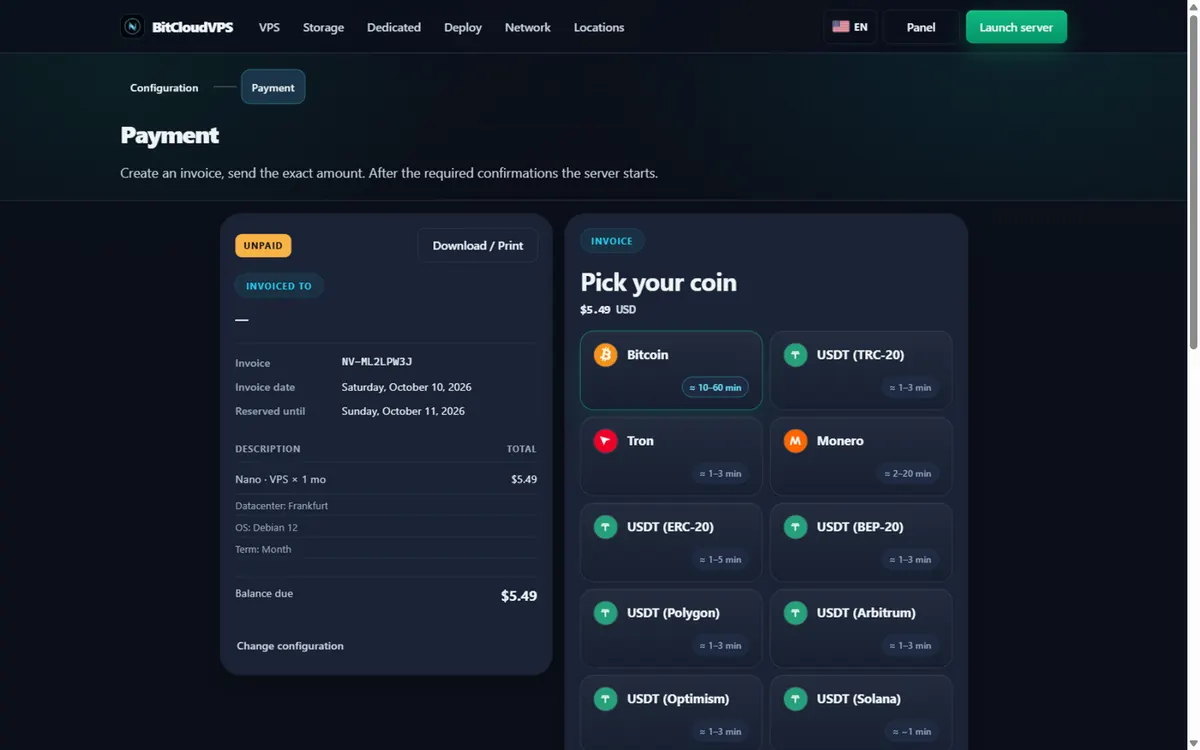
5Pick your coin. The invoice page lists BTC, XMR, LTC, DOGE and USDT on seven networks with live confirmation ETAs. The demo pays in Monero. 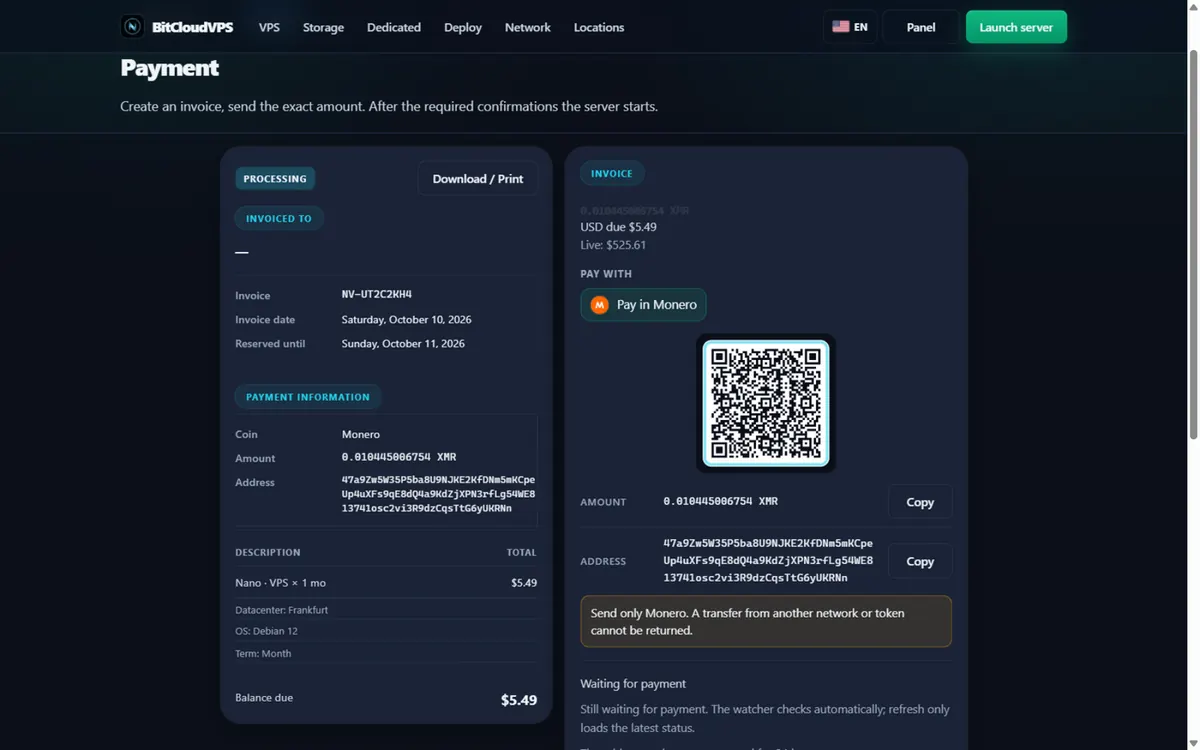
6Send the exact amount. Scan the QR or copy the address and the exact XMR amount. After the required confirmations the watcher credits the invoice automatically. 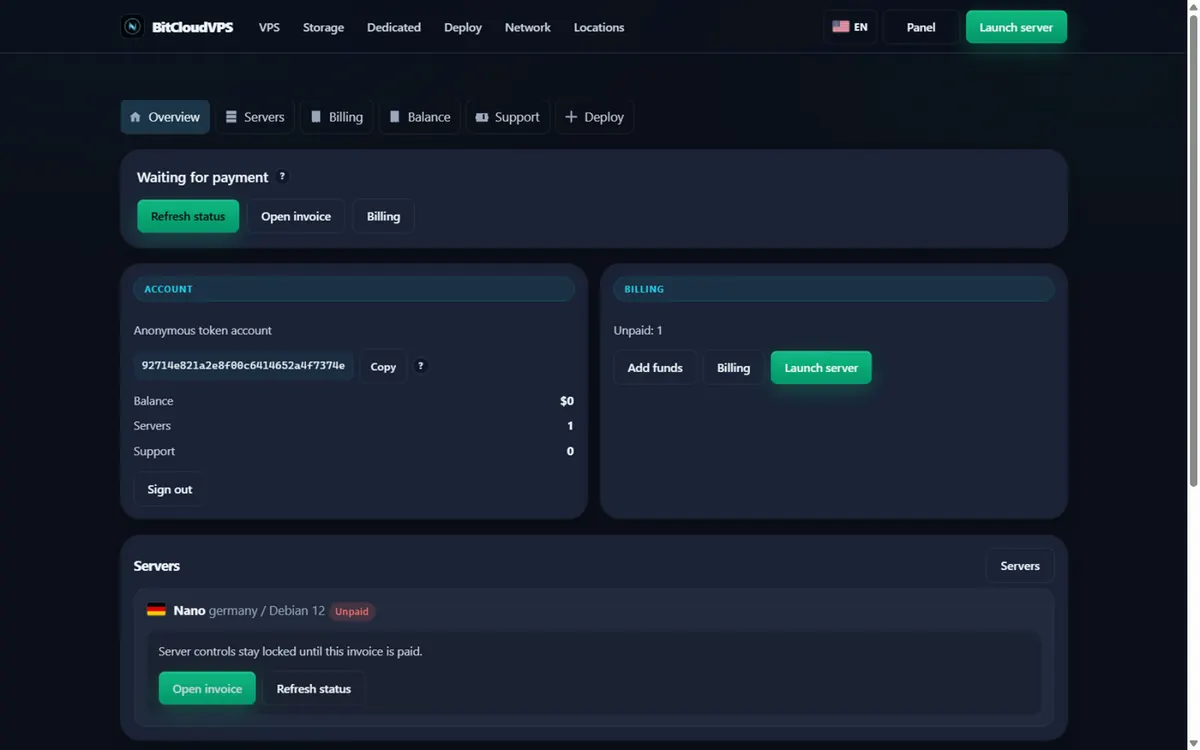
7Track it in the panel. The panel shows the account, the server and the invoice status. Controls unlock as soon as the payment confirms.


What does no KYC mean for a VPS?
No government ID, phone, or real-name check. Email (or token) plus a crypto invoice. Same rules at every tier.
Do you accept disposable email?
Yes, if it can receive the deploy mail with the IP and credentials.
Will you ask for ID after I scale up?
No. The fiftieth VPS uses the same form as the first.
Can I pay USDT after a KYC exchange withdrawal?
Yes. We credit the on-chain payment. Use a fresh wallet or Monero if you want to break that link.
Iceland and Switzerland on one account?
Yes. Same list price. Pick the flag at checkout.
Dedicated without KYC?
Yes. Same coins. Provision 2–4 hours after confirmation.
Which coin should I pick if I want the least traceable payment path?
XMR (Monero) is the usual answer because amounts are hidden on-chain. It is one of the 19 supported assets. If XMR liquidity is a problem for you, USDT on TRC-20 is cheap and stable, but the transfer is publicly visible, so fund from a wallet you control accordingly.
Can I get a VPS without giving an email address at all?
Yes. Signup supports a token-only account and email is optional. You will still receive invoices inside the panel, so keep your token safe — it is the only recovery path we can offer, which is the honest trade-off of not collecting identity data.
Do the fund-account bonuses combine with the annual −20% discount?
Yes, and they multiply in your favor: the balance is credited with the bonus when you top up ($1,000 → $1,100, $2,000 → $2,800), and invoices drawn from that balance are still priced at the term's rate — $24/mo for Business annual rather than $30 list. The discount lives on the invoice, the bonus lives on the balance.
Is there a minimum term or setup fee on a no-KYC VPS?
No setup fees, and monthly billing means zero commitment: a Nano month at list is the shortest, cheapest entry. Discounts start at the quarter (−10%) and peak at the year (−20%), except Nano, whose $36/yr flat price is already the discounted endpoint.
What does the host actually know about me?
Whatever you hand over: a signup token, an optional email address, the invoice you paid and the service traffic. No ID documents, no phone number, no KYC step exists to hand anything else over.
What won't an anonymous VPS protect against?
Self-inflicted links: personal logins from a home IP, leaked cookies, services that publish your address, and on-chain patterns that tie wallets together. The server removes one identifier; it does not fix operational mistakes.
Primary sources
Ready to launch?
Configure a VPS or dedicated server, set a password, then pay the invoice.
Network
Edge RTT
Uptime · 36h
Complaints · 36h