 BitCloudVPS
Anonymous VPS — Token Signup, USDT or XMR, From $3
Anonymous VPS hosting: email-only signup, no ID, 16 crypto payments incl. Monero, no payload logs, 21 locations. Honest about limits. From $3/mo.
Anonymous VPS hosting here means no KYC and crypto-only checkout from $3/mo — not invisibility. Token-only or email + password, no passport or phone, no payload logs. Hygiene on DNS and wallet still matters.
How to buy an anonymous VPS in four steps
1. Open deploy and pick a plan (KVM from $3/mo), a term, and one of 21 locations — including Iceland and Switzerland. 2. Sign up with an email and a password of 12+ characters. No name, no ID scan, no phone. 3. Pay with one of 19 crypto options — BTC, Monero, USDT and more; the invoice is at live rate. 4. Get root in about a minute. That is the whole KYC: there is none.
Business $24/mo (6 vCPU / 16 GB DDR5) is the production size. Crypto invoice, no KYC.
Launch nowWhat anonymous means here (checklist)
| Question | BitCloudVPS | Typical mainstream host |
|---|---|---|
| ID document at signup? | never | scan + selfie |
| Phone number? | not requested | SMS verification |
| Card payment? | no cards — crypto only | card + billing address |
| Payload logs? | no; security metadata 24 h | full logging, retained |
| Paying with Monero? | first-class checkout | rare |
| Locations outside your jurisdiction? | 21, four continents | same few regions |
Checkout rules as of October 2026.
Be precise
We do not KYC. We do not take cards. Signup is token-only or email plus a password; we can still see a txid and, if you used email, that inbox. Read the traceability guide. Paying a VPS in crypto is one layer. A personal Gmail and a named domain are another. We will not pretend those cancel.
Anonymous VPS and the hosts most often recommended for it
As published on the providers' own sites, checked against live listings in October 2026. Pick by threat model, not by marketing:
| Provider | Model | XMR | Locations | Entry |
|---|---|---|---|---|
| BitCloudVPS | crypto-only, no KYC | first-class | 21 | $3/mo |
| SporeStack | pay-per-use, no account | yes | several | credit-based |
| Njalla | privacy domain + VPS | yes | several | €15/mo class |
| 1984 Hosting | Iceland free-speech | yes | Iceland | €7/mo class |
| FlokiNET | Iceland/Romania free-speech | yes | 2 regions | €6/mo class |
Entry prices as published, October 2026 snapshot.
Abuse claims and law enforcement
Abuse and takedown claims are accepted only from local law enforcement of the facility jurisdiction - not from private senders or forwarded templates. No such precedent on file at any of the twenty-one locations. Criminal process that actually lands is another matter; the AUP always applies.
What you get
KVM from $3/mo in twenty-one locations, 16 crypto checkout options, no passport, and no phone. Dedicated starts at $79.50/mo on the same account. DDoS filtering is included. No payload logs; security metadata is retained for 24 hours.
What you do not get
A crime product or a fake WHOIS service. If you need less metadata, combine a wallet you control, a registrar that matches the threat model, and operational hygiene. We rent the computer.
Also on this site
More rankings and guides
- Best anonymous VPS 2026
- Best no-email VPS
- No-KYC VPS
- Limits of no-KYC anonymity
- How to buy an anonymous VPS
- Whonix VPS, nested virt
The money layer, precisely: 19 assets, three discounts, one flat price
Concretely what the checkout accepts: 19 crypto assets - BTC, XMR, ETH, BNB, SOL, LTC, TRX, XRP, DOGE, DASH, ADA, GRAM (TON), and USDT on seven networks (TRC-20, ERC-20, BEP-20, Polygon, Arbitrum, Optimism, SPL). Prices do not depend on the coin. Nano lists at $5.49/mo with a flat $36/yr annual price - $3/mo effective; Starter is $8.50 (2 EPYC 7443P vCPU, 4 GB ECC, 60 GB NVMe); Plus $13.50; Business $30; Pro $45; Max $60. Terms discount as month at list, quarter at -10%, year at -20%, and every plan includes NVMe with ECC memory, unmetered 1-10 Gbps ports, one IPv4 and a /64 IPv6 block. The operator is Harborline Node Ltd., Saint Kitts and Nevis; there is a fund-account bonus of +10% at $1000 and +40% at $2000 if you prefill a balance. What we will not claim: crypto payment erases the txid, and a bonus tier ties more value to one account.
One catalog, one anonymity level: Nano through Max in numbers
Anonymity is not a plan feature you pay extra for here — every tier carries the same no-KYC checkout, so the choice between plans is pure capacity math. Nano starts at $5.49/mo list with a flat $36/yr annual price; Starter adds 2 vCPU EPYC 7443P, 4 GB ECC and 60 GB NVMe at $8.50; Plus at $13.50; Business at $30 with 6 vCPU, 16 GB DDR5 ECC and 240 GB NVMe; Pro and Max at $45 and $60 close the line. All plans include NVMe + ECC storage, unmetered 1–10 Gbps ports, 1x IPv4 and a /64 IPv6 block, deployable in any of 21 datacenters from Reykjavik to Singapore.
The practical reading: the $5.49 tier and the $60 tier are equally anonymous, so buy the smallest box that fits the workload and spend the difference on term discounts or locations. A token-only signup with no email attached to a $36/yr Nano leaks nothing at purchase time; the same signup on a Max changes nothing about identity, only about capacity. That is the correct mental model — the catalog has one anonymity level and six sizes.
How the discounts and bonuses stack over a year
The money layer has exactly three levers, and they combine predictably. First, the billing term: month at list, quarter at −10%, year at −20%, with Nano pinned at $36/yr ($3/mo effective) regardless. Second, the funding route: paying per invoice keeps each transaction small; pre-funding the balance at $1,000 adds +10% in credit and at $2,000 adds +40%, so a $2,000 top-up yields $2,800 of hosting credit. Third, coin choice: 19 assets — XMR for graph privacy, USDT on TRC-20 and six other networks for cheap stable payments, BTC, GRAM, LTC and the rest for whatever wallet you already hold.
Worked example: a Business plan used all year costs $360 at list, $324 paid quarterly, or $288 paid annually. Fund a $2,000 balance once and the effective cost drops again inside the credit. One annual invoice also means one blockchain payment event per year instead of twelve — fewer public-ledger traces, fewer exchange withdrawals, less fee bleed. For a fleet, the same logic scales: prepay the account, let every server draw from it, and the payment layer collapses to a handful of transactions per year.
The three clocks of an anonymous VPS: invoice, chain, and habit
Buying an anonymous VPS is often described as one decision. It is really three, on different clocks, and keeping them separate is what makes the setup hold. The invoice clock: each term you pay is one event — month at list, quarter −10%, year −20%, Nano pre-baked at $36/yr — so annual billing means one identity-free transaction a year instead of twelve. Fewer events, fewer chances to fund a payment from a sloppy source.
The chain clock: whatever asset you send rides a public ledger unless it is XMR. BTC's graph ties addresses together forever; USDT's networks are just as public; GRAM on TON is traceable. Signup being no-KYC — optional email, token-only accounts, Harborline Node Ltd. registered in Saint Kitts and Nevis — means the account has no name in it; whether the payment has one is decided at your wallet, not at checkout. XMR is the asset built for the payment-private case, and it sits on the same invoice as the other 18 options.
The habit clock: everything after payment. Domains, DNS, recovery addresses, login IPs, the content of the server's outbound traffic — none of it is in the host's hands, and all of it can name you. The honest summary: the catalog removes identity from the hosting relationship completely, on every plan from Nano to Max at all 21 sites; anonymity of the operator remains your discipline, and no plan tier changes that.
BitCloudVPS Nano · flat $36/yr · token-only signup
Deploy in 60 secondsPayment anonymity vs operator anonymity: split the two problems
The short answer: most 'anonymous VPS' disappointment comes from treating them as one problem. Payment anonymity is a property of the coin: Monero hides sender, receiver and amount by default; BTC and USDT are public ledgers where the txid chain leads back to whatever exchange funded the wallet. Operator anonymity is a property of the account: BitCloudVPS's token-only signup - a 32-character hex with no email attached - means there is no identity file, no recovery inbox and no phone number to correlate, and connection metadata is kept at most 24 hours. Put them together and the anonymous deploy is boring: pay the XMR invoice from a self-custody wallet that was never KYC'd, hold the token offline like a seed phrase, and skip the email field. What remains visible is deliberate and small: the box exists, it bills in crypto, and whatever your traffic itself reveals. What breaks it is equally specific: an exchange withdrawal, a domain registered under your name pointing at the IP, a panel login from an identified machine. The host cannot undo those - the honest checklist on this page exists so you do the parts only you can do.
Limits: what no host can make anonymous
State the ceiling before buying anything. No host can anonymize your traffic content: TLS hides it from the wire, not from the destination service that knows your account. No host can rewrite DNS history: a domain that pointed at your VPS stays in public historic records forever, which is how projects get de-anonymized a year after they moved. No host can obscure device fingerprints, typing cadence or the timezone your SSH sessions come from. And no host can protect content the AUP prohibits - CSAM, phishing, spam, malware C2 - from being acted on; anonymous is not a word for illegal, and selling it that way is a tell. What a no-KYC crypto VPS actually delivers is a narrow, checkable promise: no identity document at signup, no card processor file, metadata at most 24 hours, and a billing entity - Harborline Node Ltd., Saint Kitts and Nevis - outside the surveillance alliances. From $5.49 list for Nano ($36/yr = $3/mo) at any of 21 locations, it is the cheapest clean starting point in the catalog - then the opsec is yours. Open checkout - no email
Where the limits are (October 2026)
Keep the threat model precise. Anonymous-adjacent hosting removes the host-side identity trail: token-only signup, optional email, no KYC review, crypto invoices that record a txid rather than a name. It does not blind the host to traffic it must carry, it does not make a logged-in panel session anonymous, and it does not protect workloads that identify themselves — an admin login from your home IP defeats the whole design. Exact limits of no-KYC anonymity. OPSEC guide. Full checklist. Payment-side note: chain analysis happens on public blockchains, not at the host. Coin choice and network choice are your OPSEC knobs, and the checkout keeps 19 of them open.
How to sign up and deploy — step by step
How to sign up and deploy — step by step
No email, no password: an access key is created at checkout and the invoice clears in crypto. Desktop shots below; phones get the mobile UI.
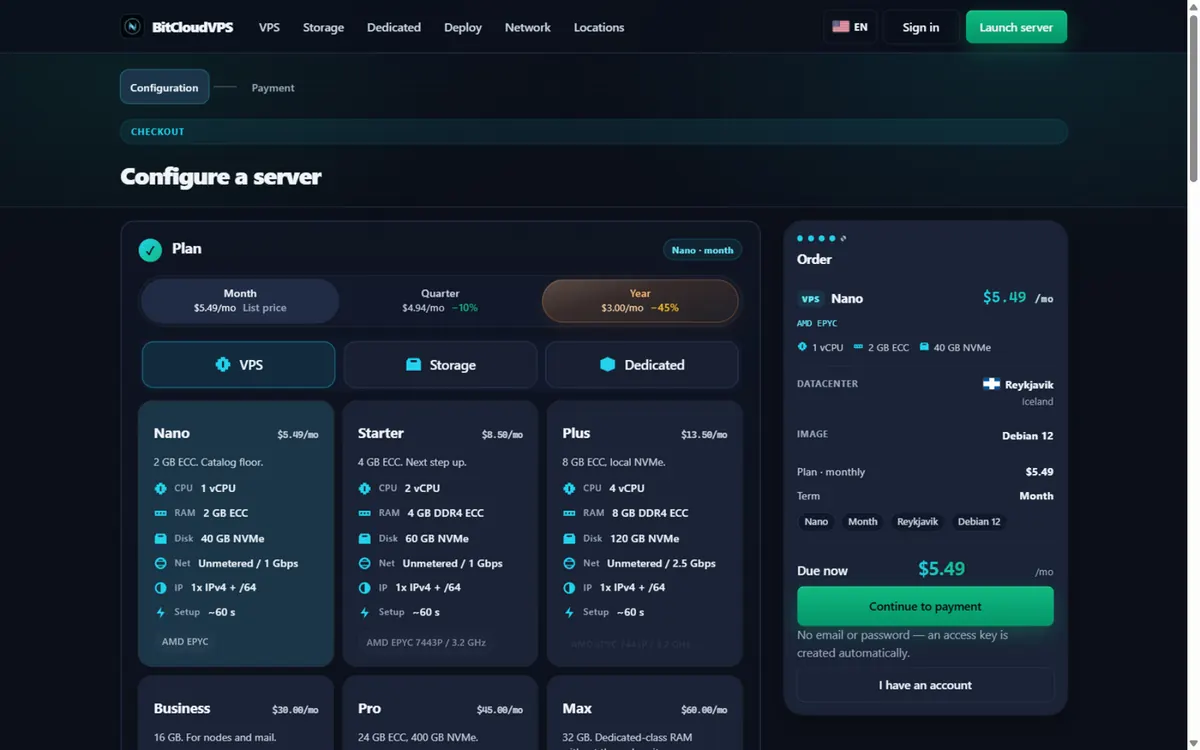
1Pick a plan. Open the deploy page and keep the Year term: Nano is $5.49/mo list and $3.00/mo flat on the annual term. No email and no password are required at any step. 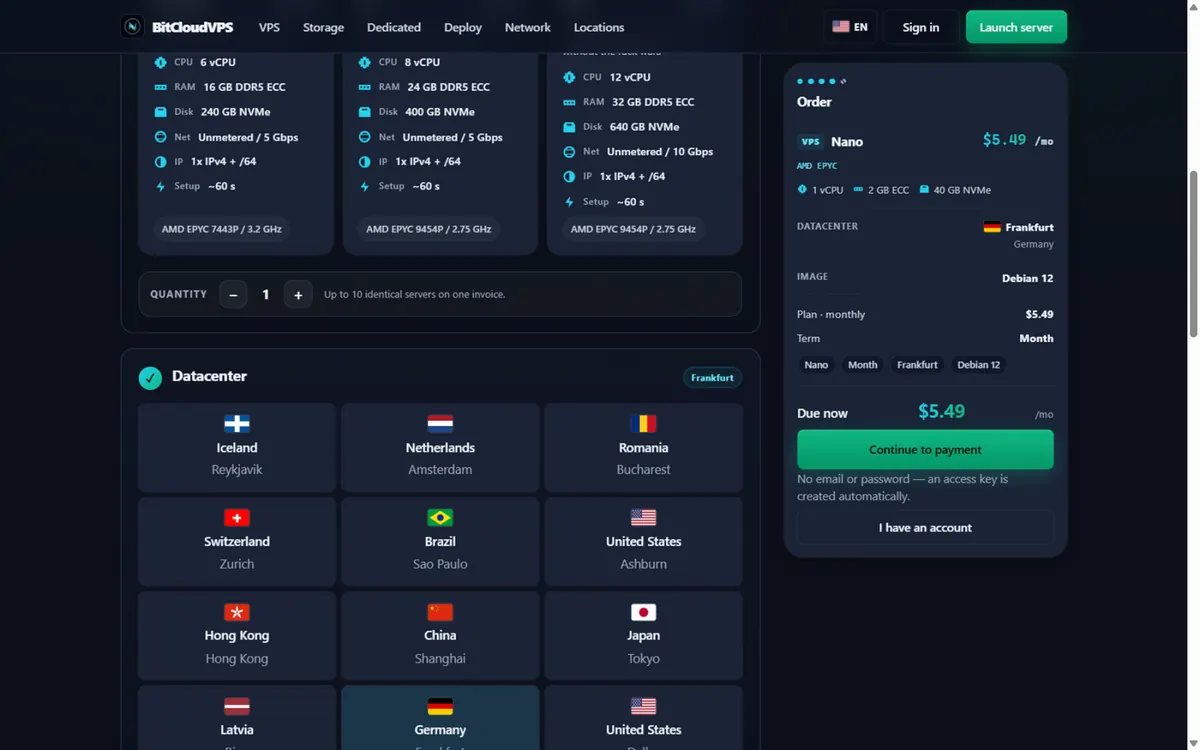
2Choose a datacenter. Click a location: 21 sites from Reykjavik to Singapore share the same price per SKU. This walkthrough selects Frankfurt (DE-CIX, Germany). 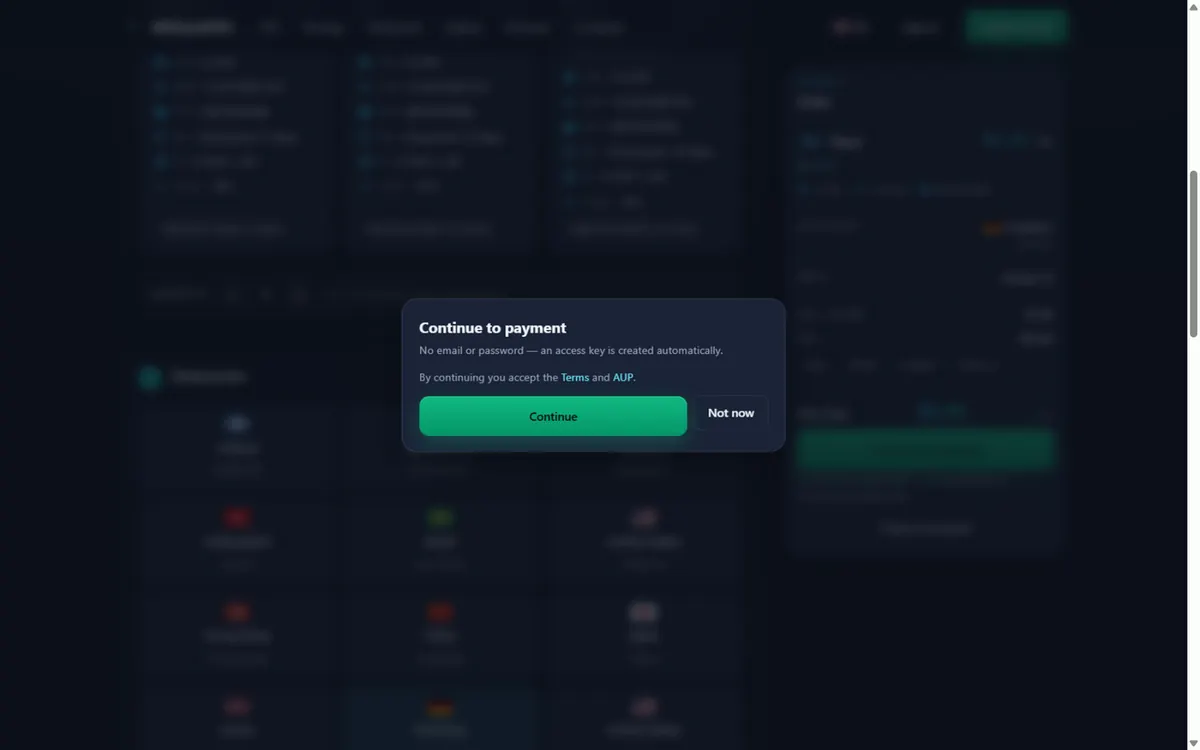
3Continue to payment. Press Continue to payment and accept the Terms and AUP. No email, no password — there is nothing to leak. 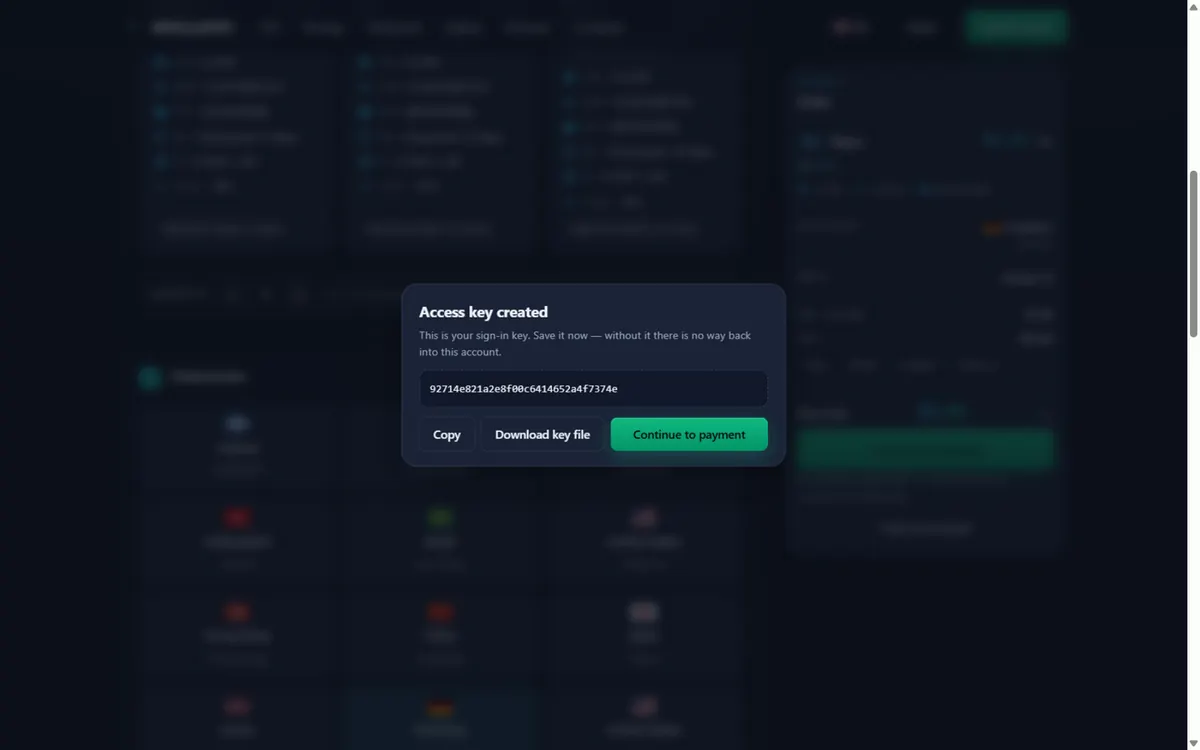
4Save your access key. An anonymous token account is created automatically. Copy or download the access key — it is the only way back into the account. 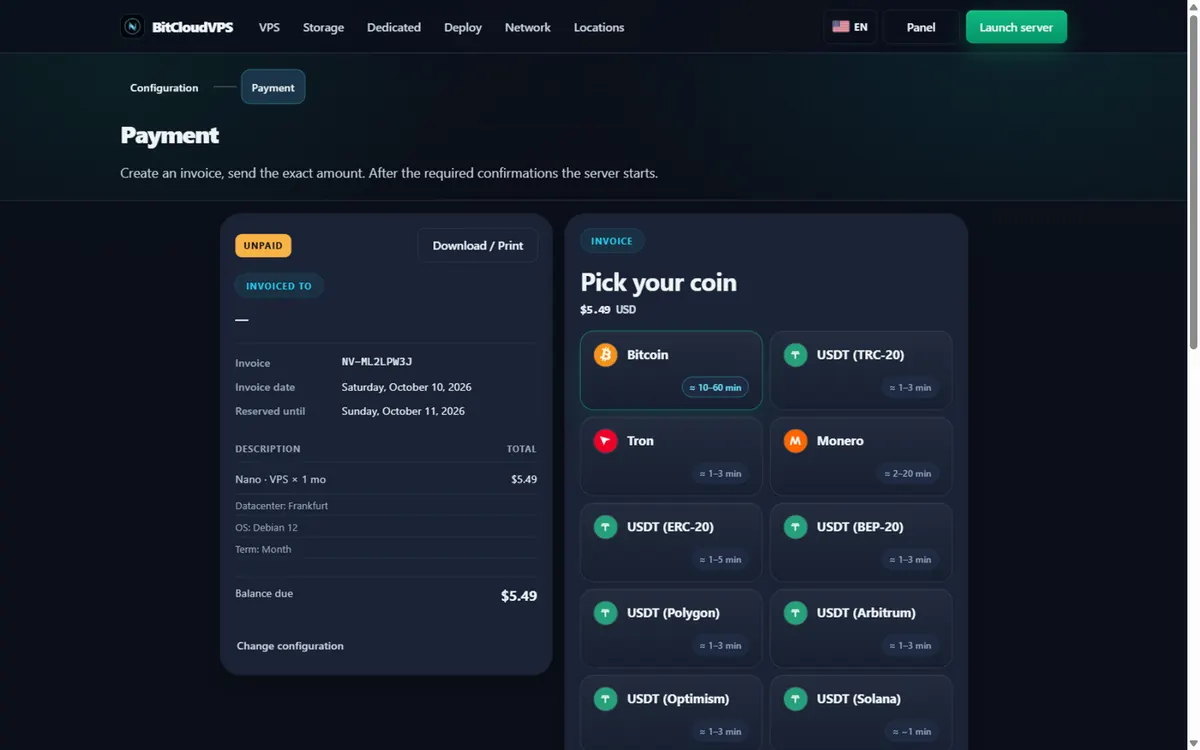
5Pick your coin. The invoice page lists BTC, XMR, LTC, DOGE and USDT on seven networks with live confirmation ETAs. The demo pays in Monero. 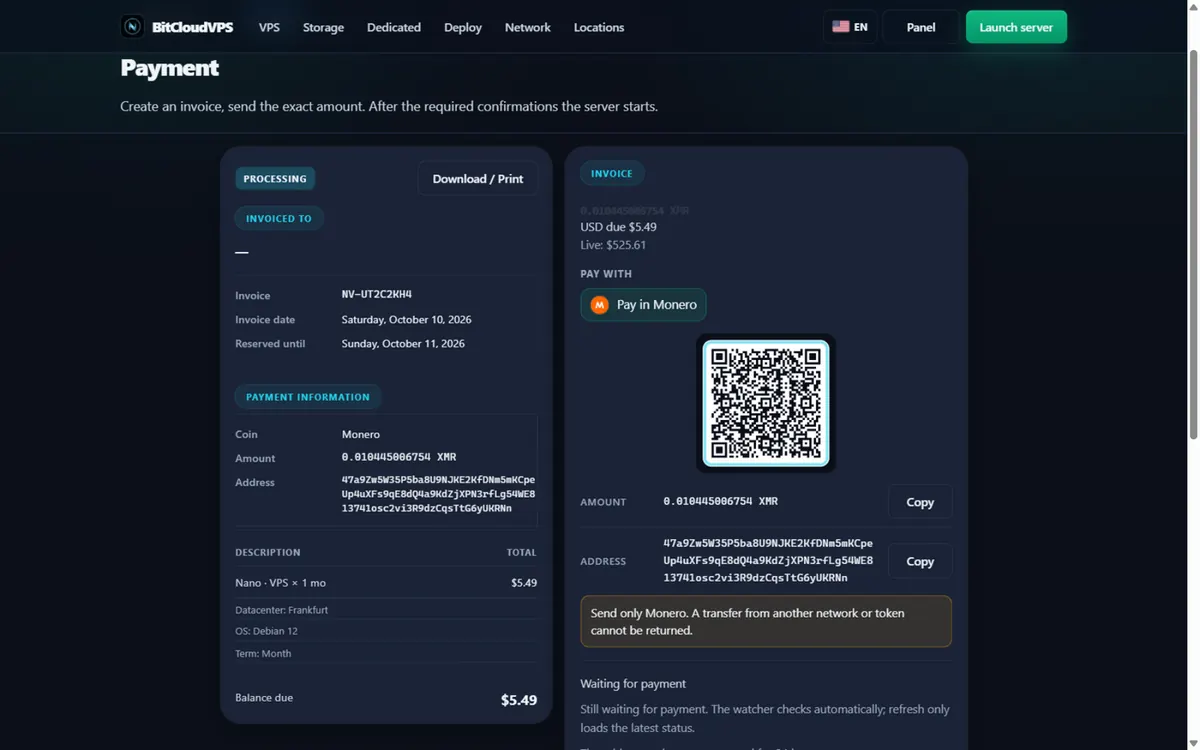
6Send the exact amount. Scan the QR or copy the address and the exact XMR amount. After the required confirmations the watcher credits the invoice automatically. 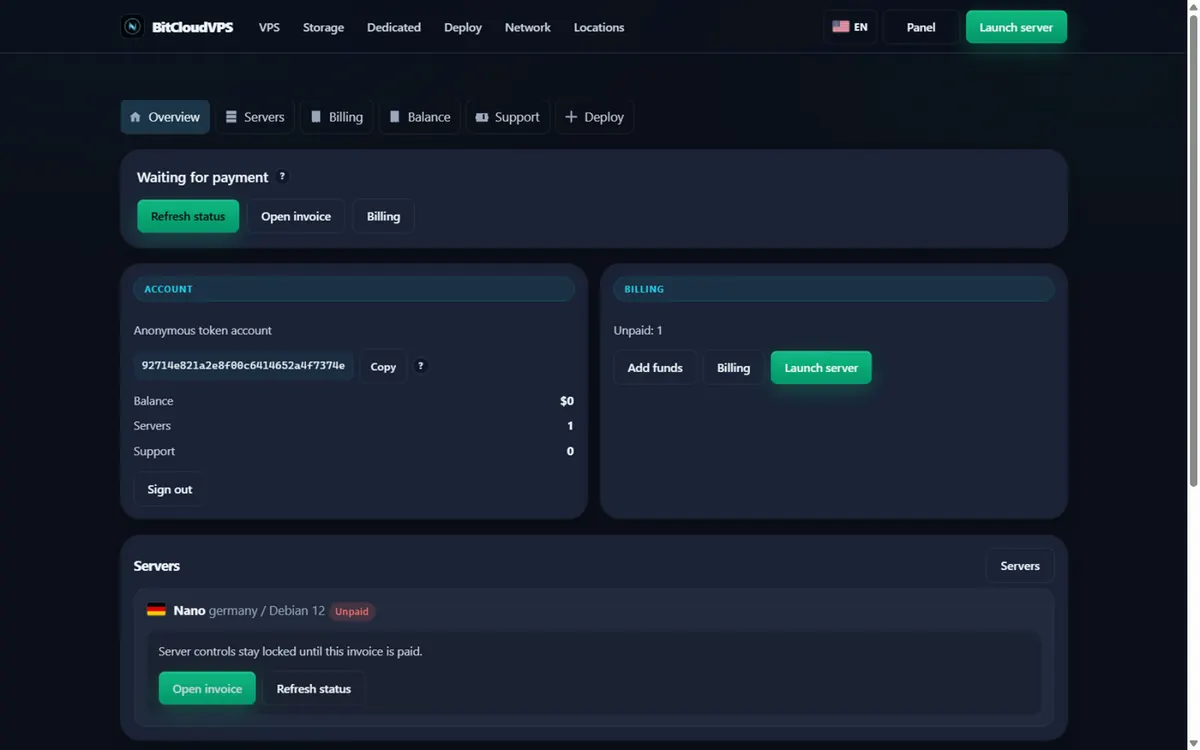
7Track it in the panel. The panel shows the account, the server and the invoice status. Controls unlock as soon as the payment confirms.


Logs
No payload capture. Billing and panel actions retained.
Phone?
Not required. Not requested.
Real name?
No. Email and a password are the whole signup.
Is an anonymous VPS legal?
In most jurisdictions, yes — renting a server without ID is legal; what you run on it is governed by the AUP and local law. See <a href="../guides/is-offshore-hosting-legal/">is offshore hosting legal</a>.
Which coin is most private?
Monero: sender, receiver and amount are hidden by default. BTC and USDT remain available for stable quotes.
What are the fund-account bonus tiers and are they worth using anonymously?
They add +10% at a $1000 balance and +40% at $2000. The trade-off is yours to weigh: prefunding concentrates value in one account and one txid history, where paying per period in XMR spreads it. The discount is real; so is the concentration.
Do bigger plans ask for more identity than Nano?
No. The checkout is identical at every tier: token-only signup, optional email, no ID documents at any price point from the $5.49 Nano to the $60 Max and the $449.50 Ultra dedicated.
Is pre-funding a $2,000 balance itself anonymous?
The top-up is as anonymous as the coins you fund it with — XMR keeps amounts and sender hidden, public-chain coins leave a visible transfer. The account side does not add identity: no card, no KYC, optional email.
Does paying annually make an anonymous VPS more or less private?
More, in practice: one invoice a year means one on-chain event, one funding decision, and no monthly rhythm that can drift into careless sources. The −20% annual discount is a privacy convenience as much as a price move — just verify the workload on a monthly term before committing the year.
Which coin should I use for the most anonymous VPS purchase?
Monero. XMR hides sender, receiver and amount on-chain, so the payment leg publishes nothing to trace. BTC works at the same USD price but its public ledger links the deposit back to wherever the coins came from - usually an exchange with its own KYC file on you.
Is buying an anonymous VPS with crypto legal?
Buying hosting without identity documents is legal in most jurisdictions - privacy is not an offense. What you host remains fully subject to law and to the AUP everywhere: anonymity changes who knows about the server, never what is lawful to run on it.
What does the host actually know about me?
Whatever you hand over: a signup token, an optional email address, the invoice you paid and the service traffic. No ID documents, no phone number, no KYC step exists to hand anything else over.
What won't an anonymous VPS protect against?
Self-inflicted links: personal logins from a home IP, leaked cookies, services that publish your address, and on-chain patterns that tie wallets together. The server removes one identifier; it does not fix operational mistakes.
Primary sources
Ready to launch?
Configure a VPS or dedicated server, set a password, then pay the invoice.
Network
Edge RTT
Uptime · 36h
Complaints · 36h