 BitCloudVPS
Buy a VPS With Crypto — 19 Coins, USDT on 7 Chains
Email and password, live-rate invoice, 14 coins. No card, no ID, no KYC. BTC, XMR, USDT and more. Iceland and Switzerland. Deploy in about a minute.

Email and password, live-rate invoice, 14 coins. No card, no ID, no KYC. BTC, XMR, USDT and more. Iceland and Switzerland. Deploy in about a minute.
How to buy a VPS with crypto
Open deploy. Pick a VPS plan, a term, a datacenter (including Iceland and Switzerland) and an OS. Enter email. Set a password of 12+ characters. On the next page pick BTC, XMR, USDT (four nets), ETH, BNB, SOL, LTC, TRX, XRP, DOGE, DASH, ADA or GRAM (TON). Send the exact amount in one transfer. No card form and no KYC step after $200.
Business $24/mo (6 vCPU / 16 GB DDR5) is the production size. Crypto invoice, no KYC.
Launch nowWhat anonymous means here (and what it does not)
| Step | What BitCloudVPS asks | What we do not ask |
|---|---|---|
| Signup | email + password | name, ID scan, phone, address |
| Payment | crypto invoice at live rate, 14 coins incl. XMR | card number, billing address, 3-D Secure |
| Operation | root access, custom ISO, editable PTR | traffic inspection or content monitoring |
| Limit | — | anonymity is not immunity: valid court orders in the server's jurisdiction still apply |
Checkout rules current as of October 2026.
Anonymity next to the hosts most often recommended
Providers this page is usually compared with, entry facts as published on their own sites (checked against live listings in October 2026):
| Provider | Known for | XMR | No-KYC signup | Entry price |
|---|---|---|---|---|
| BitCloudVPS | 21 locations, 14-coin checkout, ECC NVMe | first-class | yes — email only | $3/mo (Nano, list price) |
| SporeStack | pay-per-use, no account | yes | yes | per-hour credit model |
| Njalla | privacy domain + VPS | yes | yes | €15/mo class |
| 1984 Hosting | Iceland free-speech tradition | yes | yes | €7/mo class |
| AnubizHost | email-only signup, "no ID ever" | yes | yes | $19.99/mo (as advertised) |
| EQVPS | crypto-only, EU NVMe, 60s provisioning | stablecoin only | yes | $8/mo |
| ServerZ | "no logs" positioning | yes | yes | ~$0.021/hr |
Entry prices as published, verified in October 2026. Not a ranking — pick the tool that fits.
Search phrases this page answers
Buy VPS anonymously with crypto. Buy a VPS with Bitcoin. Buy VPS with USDT. Pay for a VPS with BNB, DOGE, DASH, ADA, XRP or GRAM (TON). No-KYC VPS. VPS no ID. Anonymous VPS hosting. Crypto VPS hosting. Offshore VPS paid in crypto. The checkout is the same sentence in every phrasing: email, password, live-rate invoice, no passport.
What people put on it
Self-hosted WireGuard (the protocol Mullvad, Proton VPN and IVPN also document), Minecraft or CS2, a pruned Bitcoin node, Matrix, legal adult CMS, ordinary sites. We rent root. Official install docs are linked from the playbooks.
Also on this site
Big disks, same invoice
The same 16-coin checkout covers storage: buy storage VPS with crypto — 1–5 TB NVMe from $24/mo.
More rankings and guides
- USDC / USDT VPS
- Monero VPS
- x402 VPS (USDC on Base)
- No-KYC VPS
- Best crypto-only VPS
- How to buy an anonymous VPS
Picking a network when the coin is USDT
USDT is one asset in the checkout but not one network. BitCloudVPS accepts it on seven: TRC-20, ERC-20, BEP-20, Polygon, Arbitrum, Optimism and SPL. The token is the same dollar peg on each; what differs is the fee you burn to move it and how fast it settles before provisioning starts.
The practical rule most buyers use: for small invoices — a $5.49 Nano month or a $36 Nano year — a low-fee network keeps the payment cost proportional to the order. For larger invoices, such as a Business ($30/mo) or a dedicated Start ($79.50/mo), the fee difference across networks is noise relative to the total, so you can pick on convenience instead.
- 19 checkout assets in total: BTC, XMR, ETH, BNB, SOL, LTC, TRX, XRP, DOGE, DASH, ADA, GRAM (TON) and USDT on those 7 networks.
- No-KYC checkout; email optional; token-only signup supported.
Whatever network you choose, send from a wallet you control — exchange withdrawals work, but they attach the exchange's withdrawal trail to your payment.
Nano at $36/yr flat: the reference price every other option bends around
Start from the floor and the rest of the decision gets easier. Nano is $5.49/mo list but $36/yr flat — $3/mo effective — and that number is the yardstick for everything else on this checkout: Starter at $6.80/mo on the annual term, Plus above it, Business at $24/mo on the year, up to Max. Every one of those prices is payable in any of the 19 supported assets: BTC, XMR, ETH, BNB, SOL, LTC, TRX, XRP, DOGE, DASH, ADA, GRAM on TON, and USDT on seven networks (TRC-20, ERC-20, BEP-20, Polygon, Arbitrum, Optimism, SPL). There is no card field to fall back to — crypto is not an alternative rail here, it is the rail.
Why the reference matters: the most common over-buy at signup is capacity nobody uses by month two. A Nano year costs less than a single Business month at list, and it answers the real questions — is the route right for my users, is the jurisdiction the one I want, does the no-KYC flow hold (token-only signup, optional email, no ID step) — before you commit serious money. Scale up when a workload proves it needs the vCPUs or RAM, not because the plan names sounded reassuring.
And the term stack, since it applies to every plan including Nano's neighbors: quarter −10%, year −20%, with the funding bonuses ($1,000 +10%, $2,000 +40%) operating at the balance layer above them. Discount decisions are catalog-wide; none of them depend on which coin you pay with.
BitCloudVPS Nano · $36/yr flat · any of 19 assets
Deploy in 60 secondsThree buyer scenarios and the asset each one should reach for
Scenario one: the privacy-first buyer. The payment graph is part of the threat model, so the answer is XMR on every invoice, sized per term. This buyer pays per invoice rather than pre-funding, keeps amounts modest, and accepts that no host — this one included — can make application-layer identity (domain WHOIS, login IPs) disappear.
Scenario two: the operator with recurring bills. Several servers, renewals stacking monthly. This buyer funds a balance once — +10% at $1,000, +40% at $2,000 — in whatever asset is cheapest to source that week, then lets every invoice draw from credit. Fewer on-chain events, the bonus out-earns the term discounts at the $2,000 tier, and the credit works across all 21 racks and every line from Nano to storage.
Scenario three: the stable-quote buyer. A freelancer or small business that wants hosting to be a predictable dollar cost. USDT on TRC-20 is the workhorse: fee a rounding error, price not moving between quote and confirmation. This buyer takes the annual term's −20% for predictability and rarely touches anything else in the asset list.
Three scenarios, one checkout: no asset changes the plan price, the discount schedule, or what the host knows — which is deliberately little, and worth restating rather than implying.
BitCloudVPS Starter · $6.80/mo on the annual term · 21 racks
Deploy in 60 secondsThe honesty section: what a crypto checkout does not hide
No-KYC here means the hosting relationship holds no identity: token-only signup is supported, email is optional, payment is on-chain, and there is no card processor to leak metadata around the invoice. That is a real boundary and we state it as the product, not a bonus. What it does not mean is anonymity in every layer you touch. Buy BTC on a KYC exchange and withdraw to pay, and the exchange's records tie your name to that withdrawal forever — the public ledger does the rest for anyone motivated. Register the domain in your legal name and no VPS choice undoes it. Log into the box daily from your home line and the payment rail is irrelevant.
Also on the honest list: abuse and law-enforcement process still exists. A hosting relationship without identity is not a jurisdiction without law; notices are handled by policy, and serious crimes are not a use case any legitimate host will shield. And on-chain privacy is asset-dependent: XMR obfuscates the graph, BTC and the USDT networks do not — "crypto" is not one privacy level, it is nineteen different ones.
We publish this because pages that skip it oversell, and buyers who believed the oversell are the ones who burn out on hosting churn. The realistic promise: an invoice that does not name you, a signup that does not ask, and prices that do not depend on either.
BitCloudVPS · token-only signup · 19 assets · 21 locations
Deploy in 60 secondsNineteen assets, one decision framework
The checkout takes 19 assets — BTC, XMR, ETH, BNB, SOL, LTC, TRX, XRP, DOGE, DASH, ADA, GRAM on TON, and USDT on seven networks (TRC-20, ERC-20, BEP-20, Polygon, Arbitrum, Optimism, SPL) — which is more choice than most buyers need and the reason a framework beats a favorite. Sort the menu by three questions. Privacy of the payment graph: XMR is the only asset whose ledger hides amounts and counterparties; BTC and ETH are fully public; USDT inherits the transparency of its chain. Price stability: USDT quotes the invoice in dollars, so what you approve is what settles; everything else carries market drift between quote and confirmation. Fee profile: TRX, LTC, and TRC-20 USDT cost cents at any size; BTC and ERC-20 vary with the mempool and punish small invoices.
The intersection gives three honest defaults. Small invoices — a $36 Nano year, a $6.80 Starter month — go out on TRC-20 USDT, LTC, or TRX, where a few dollars of fee would be a visible percentage. Privacy-critical orders of any size go out on XMR, accepting fee and volatility as the cost of an untraceable payment. Large stable invoices — a $288 Business annual or a four-figure dedicated term — can take BTC from long-held coins without the fee registering. Two mechanics complete the picture: invoices are settled on-chain to the account, so no bank or processor sits in the middle, and the fund-account bonus ($1,000 adds 10%, $2,000 adds 40%) applies to whatever you deposit, making a single XMR or USDT pre-fund the cheapest way to run several servers. Throughout, signup stays token-based with optional email — the crypto payment is one layer of a checkout designed so no layer asks for a name.
The price sheet, October 2026 catalog check
Verified against the current catalog, not a cached snapshot. Nano $5.49 (1 vCPU / 2 GB ECC / 40 GB NVMe; flat $36/yr = $3/mo effective), Starter $8.50 (2 vCPU / 4 GB DDR4 ECC / 60 GB NVMe), Plus $13.50 (4 vCPU / 8 GB DDR4 ECC / 120 GB NVMe), Business $30 (6 vCPU / 16 GB DDR5 ECC / 240 GB NVMe), Pro $45 (8 vCPU / 24 GB DDR5 ECC / 400 GB NVMe), Max $60 (12 vCPU / 32 GB DDR5 ECC / 640 GB NVMe); storage plans run $30-$70/mo for 1-5 TB NVMe (8 vCPU / 32 GB at the top tier); dedicated boxes from Start $79.50 (Intel Xeon E-2388G, 32 GB DDR4 ECC) to Ultra $449.50 (2 x AMD EPYC 9474F / 3.6-4.1 GHz, 512 GB DDR5 ECC-R), all with IPMI and DDoS scrubbing. Terms move the price, not the hardware: month at list, quarter at -10%, year at -20%. Checkout takes 19 checkout assets — BTC, XMR, ETH, SOL, LTC, TRX, XRP, DOGE, DASH, ADA, GRAM (TON) and USDT on 7 networks — no KYC step, email optional, token-only signup available. How the crypto invoice works. Paying with Bitcoin. One honest limit: list prices are what the catalog shows at publish; the invoice always prices your coin at the live market rate at the moment you generate it.
Peer check: coin lists differ even among crypto-friendly hosts: NulNet invoices in four coins with no USDT rail, while VPSbit carries nineteen coins including USDT on seven networks and GRAM (TON). Confirm on their checkouts before you buy. Checked October 2026.
How to sign up and deploy — step by step
How to sign up and deploy — step by step
No email, no password: an access key is created at checkout and the invoice clears in crypto. Desktop shots below; phones get the mobile UI.
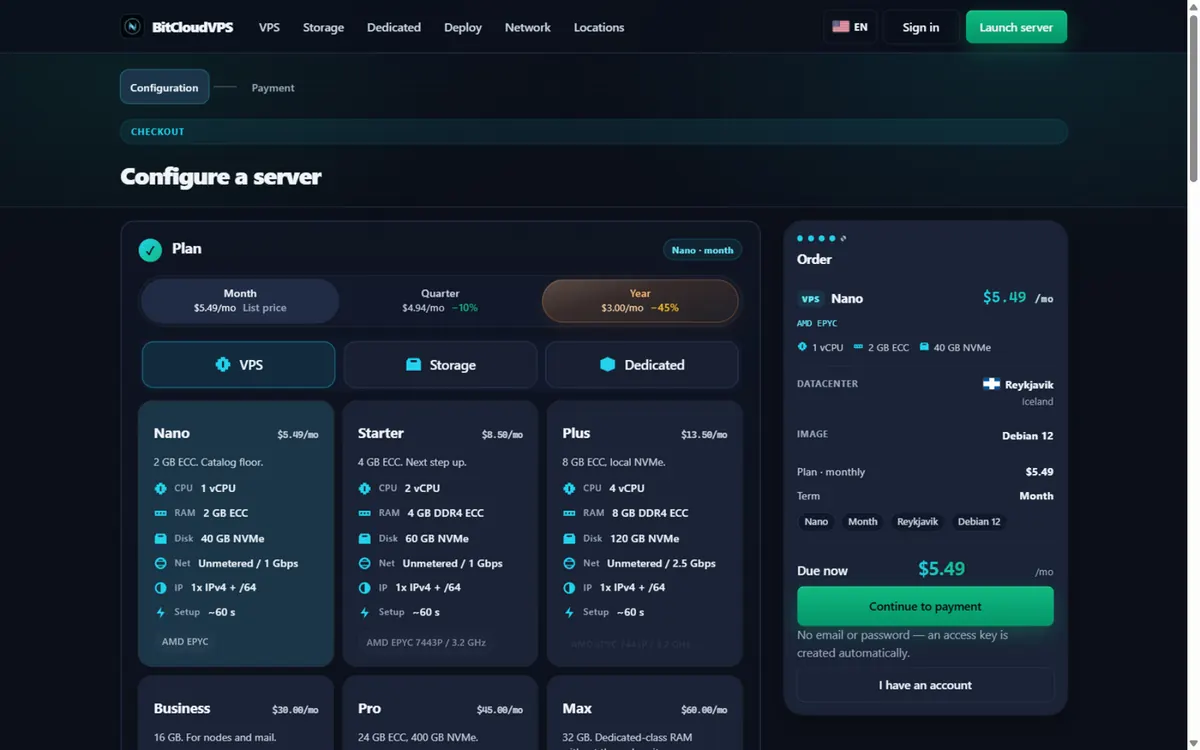
1Pick a plan. Open the deploy page and keep the Year term: Nano is $5.49/mo list and $3.00/mo flat on the annual term. No email and no password are required at any step. 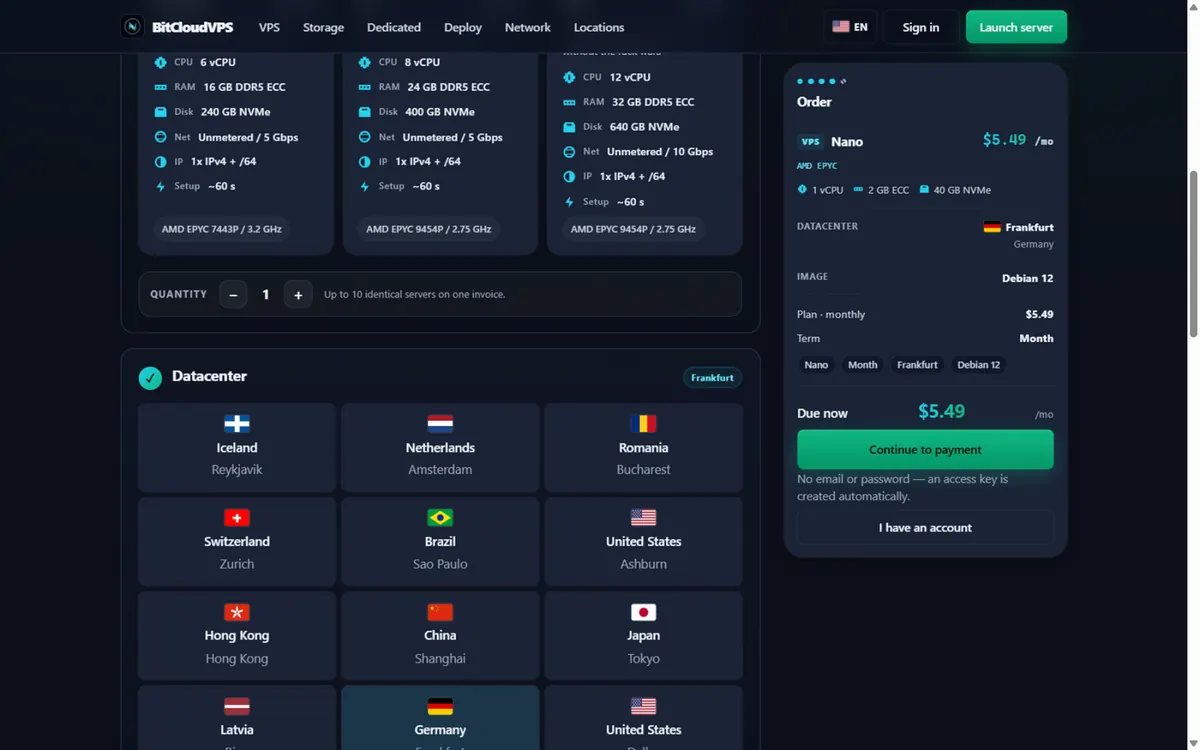
2Choose a datacenter. Click a location: 21 sites from Reykjavik to Singapore share the same price per SKU. This walkthrough selects Frankfurt (DE-CIX, Germany). 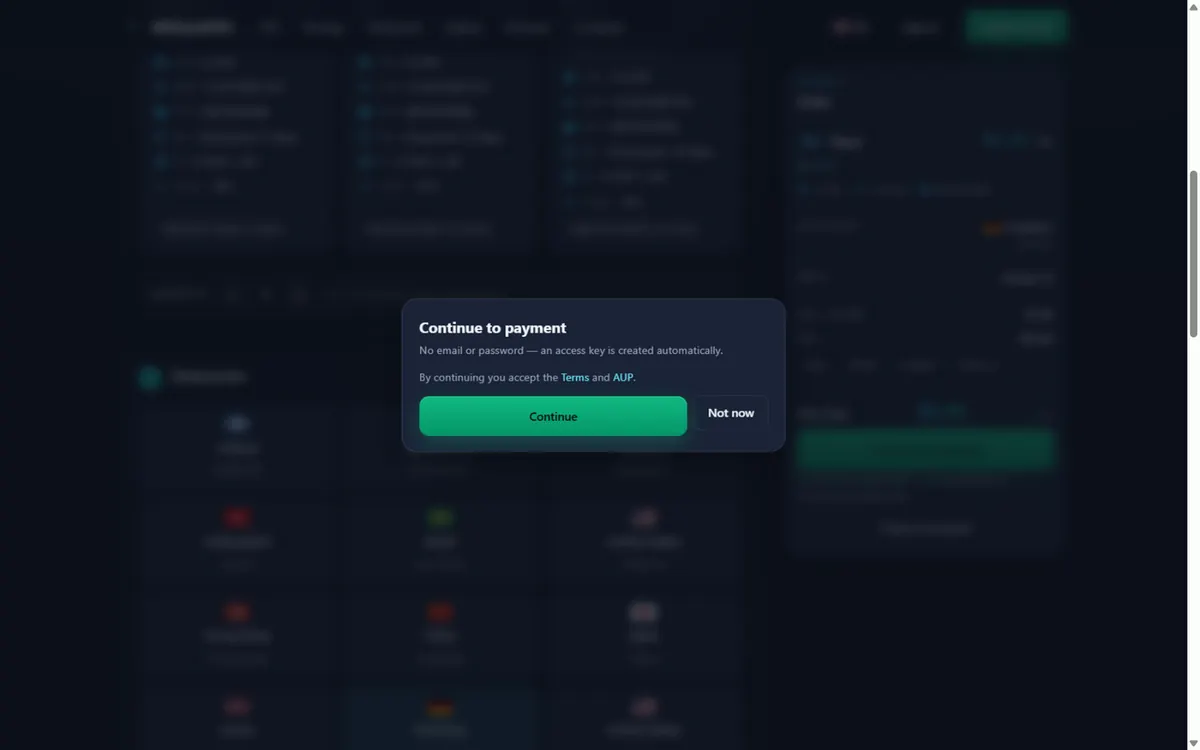
3Continue to payment. Press Continue to payment and accept the Terms and AUP. No email, no password — there is nothing to leak. 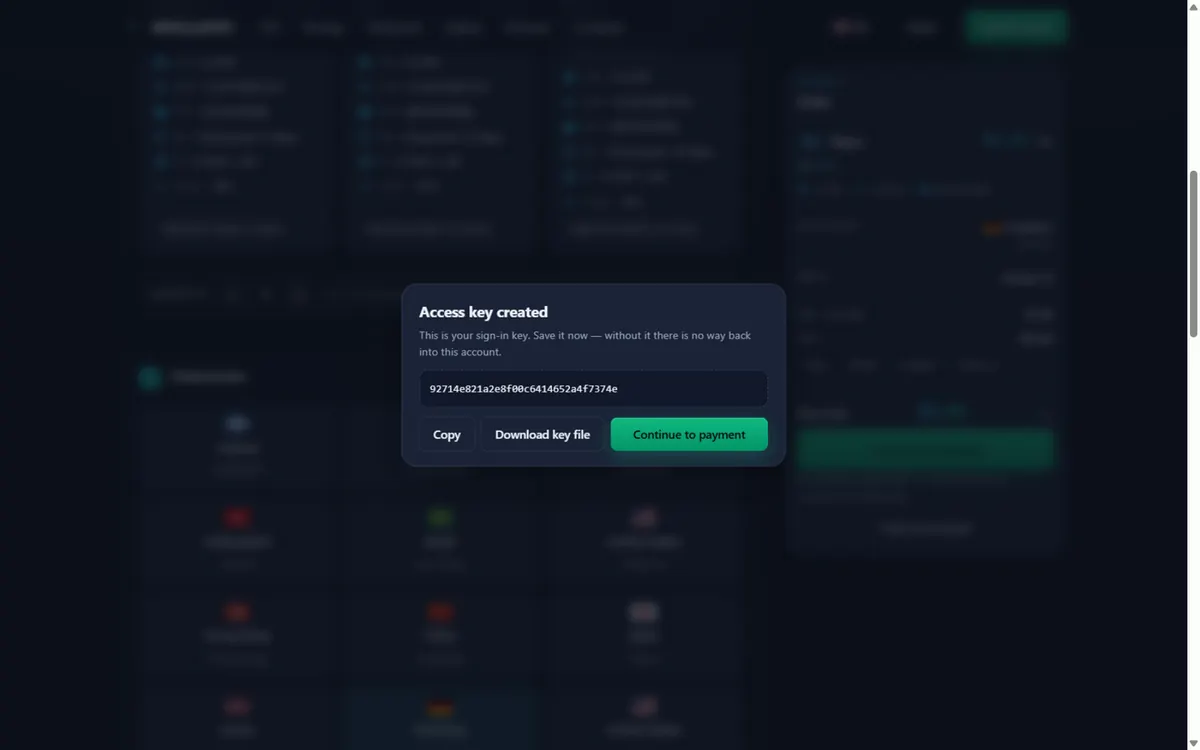
4Save your access key. An anonymous token account is created automatically. Copy or download the access key — it is the only way back into the account. 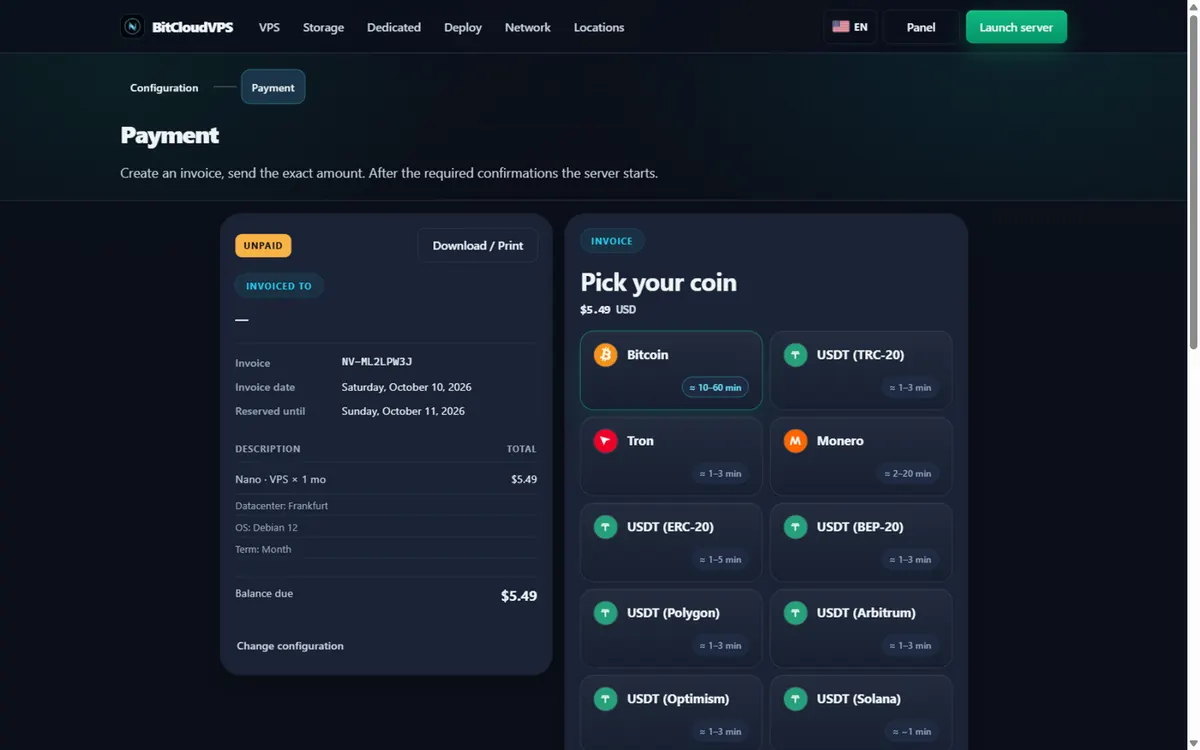
5Pick your coin. The invoice page lists BTC, XMR, LTC, DOGE and USDT on seven networks with live confirmation ETAs. The demo pays in Monero. 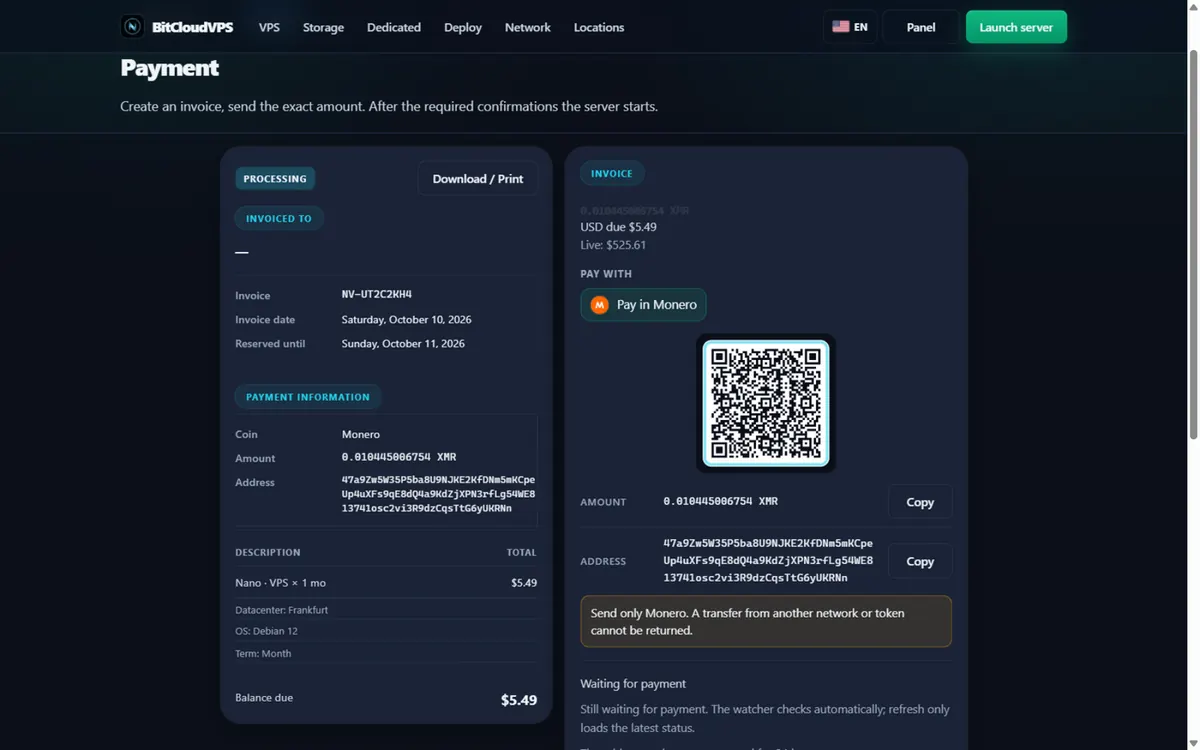
6Send the exact amount. Scan the QR or copy the address and the exact XMR amount. After the required confirmations the watcher credits the invoice automatically. 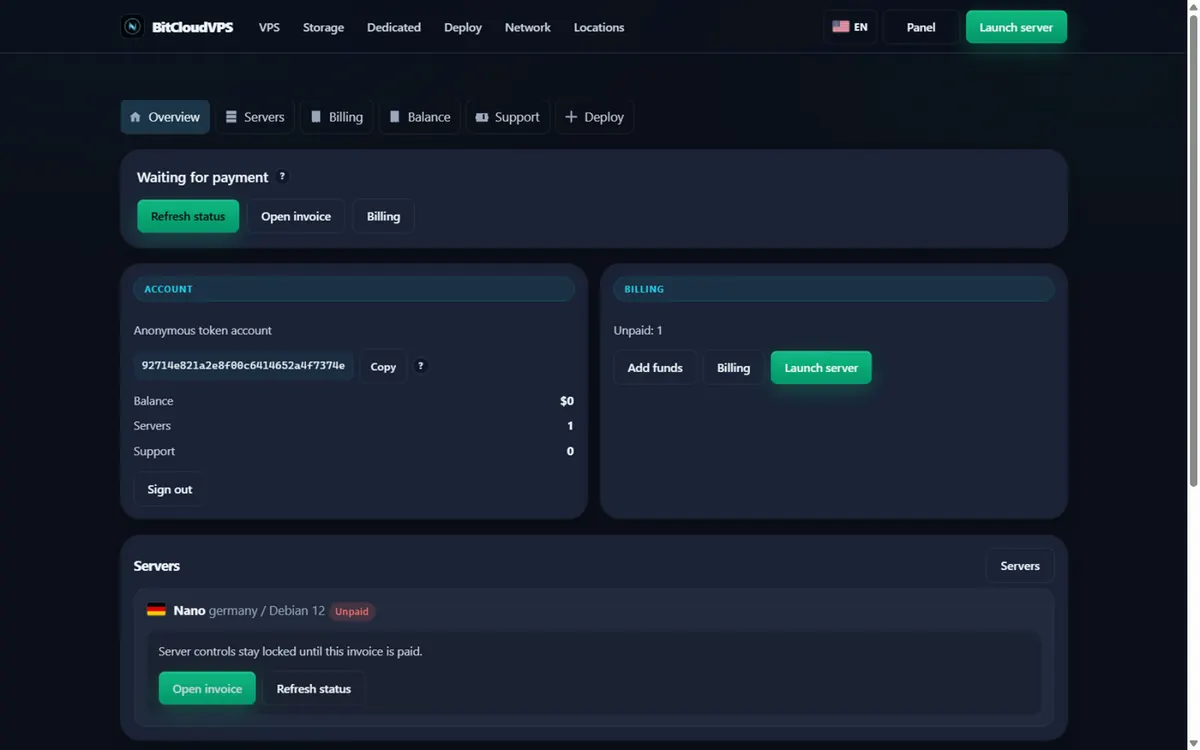
7Track it in the panel. The panel shows the account, the server and the invoice status. Controls unlock as soon as the payment confirms.


Dedicated instead?
Buy a dedicated server with cryptocurrency from $79.50/mo on the same account. No KYC on metal either.
Exchange KYC?
If you bought coins on an exchange, that KYC is theirs. Ours is still email and password.
Do you ask for my real name?
No. Signup is email and password. Nothing on the invoice page asks for a legal name, an ID document or a phone number.
Which coin hides the payment best?
Monero. XMR hides sender, receiver and amount by default; BTC and USDT stay available when you want a stable quote.
Can I pay for a VPS with a stablecoin instead of a volatile coin?
Yes. USDT is accepted on seven networks — TRC-20, ERC-20, BEP-20, Polygon, Arbitrum, Optimism and SPL — so the invoice amount in dollars maps directly to the token you send, without timing the send against a price move the way a BTC or ETH payment can require.
How do the −10% and −20% term discounts interact with a +10% or +40% balance bonus?
They stack because they hit different layers: the term discount reduces the invoice (quarter −10%, year −20%), while the bonus added credit to the balance when you funded it ($1,000 +10%, $2,000 +40%). A year of Business billed at the −20% rate settles from a $2,000-funded balance's $2,800 of credit.
Is there any plan or line the crypto checkout does not cover?
No. VPS from Nano to Max, the storage line ($24–$56/mo, 1–5 TB), and dedicated servers from Start to Ultra all settle through the same 19-asset checkout, with the same no-KYC flow and the same term discounts at every one of the 21 locations.
What does the cheapest plan cost right now?
Nano lists at $5.49/mo with a flat $36/yr annual price. The quarter term takes -10% and the year -20% off list on every plan. Hardware is identical whichever of the 19 assets settles the invoice.
How fast is a VPS after I pay?
About a minute after the payment watcher marks the invoice paid. Dedicated servers are 2-4 hours because of racking and IPMI. Provisioning never waits on a KYC review because there is no KYC review.
Primary sources
Ready to launch?
Configure a VPS or dedicated server, set a password, then pay the invoice.
Network
Edge RTT
Uptime · 36h
Complaints · 36h